GEOPARK
WHAT IS A GEOPARK?
A geopark is a unified geographical area where sites and landscapes of international geological significance are managed with a holistic approach to protection, education, and sustainable development, leveraging geological heritage in connection with all other aspects of natural and cultural heritage. It has a national character, and if its sites, landscapes, and geological values are of international importance, it can be proposed to UNESCO for designation as a global geopark.
HISTORY
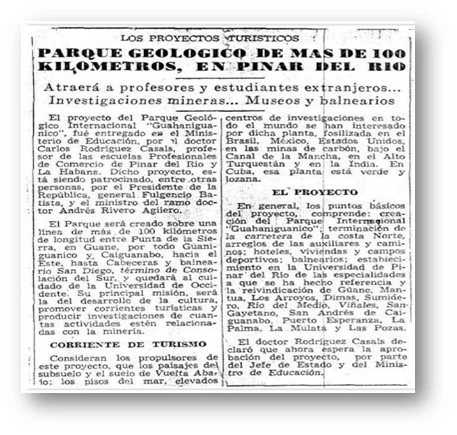
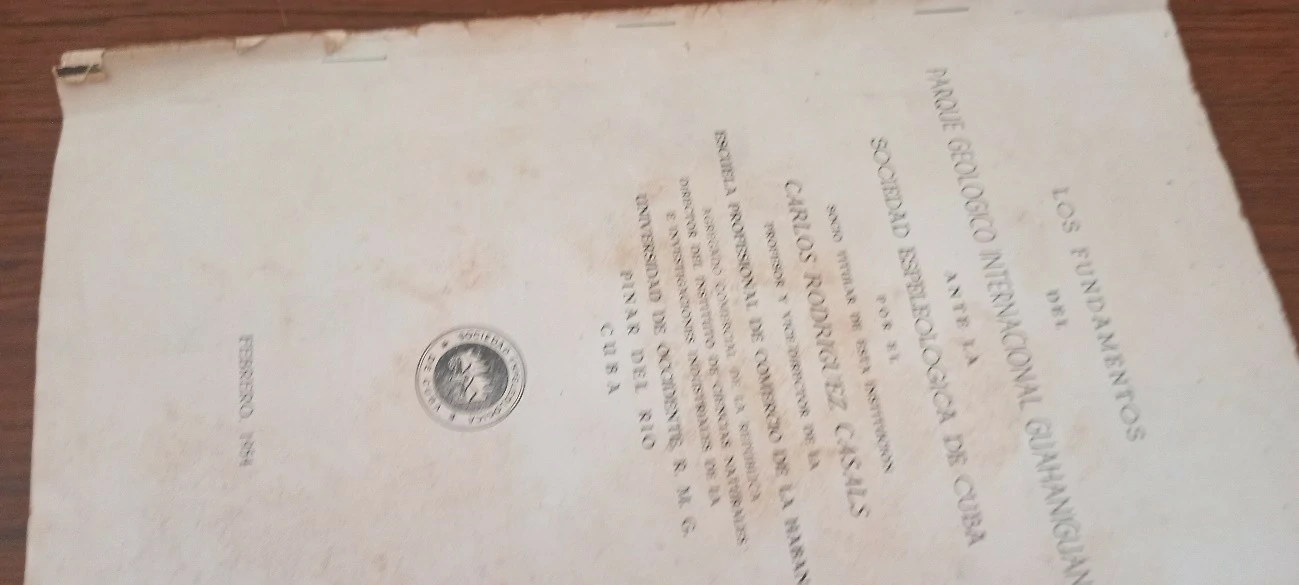
The first known attempt to create an International Geological Park in Cuba dates back to 1954, when Dr. Carlos Rodríguez Casals proposed a project with these characteristics in Pinar del Río. It would extend across Guaniguanico over a 100 km line, from Punta de la Guane Mountains to San Diego de los Baños, including the entire Viñales Valley and its surroundings. The goal was to promote scientific research and tourism development in the region. The project was sponsored by then-President Fulgencio Batista, and although the news was published in the newspaper El País, it was never executed.
Subsequently, researchers working in the Viñales region recognized the importance of the existing geological heritage and the need to protect it for future generations. It was not until the first decade of the 21st century that work began on identifying geological and educational sites of interest.
In 2006, Corvea J.L. et al. published an article on some points of geological and educational interest in Viñales National Park. In 2007, Gutiérrez M.R. et al. surveyed several geosites, classifying them into three main types based on a series of weighted parameters.
The most comprehensive work on the topic began in late 2015 with the presentation of a project for the geological and geomorphological study of Viñales National Park. The work involved a detailed update of the area’s geology and geomorphology, with the review and description of existing geosites. This information led to the preparation of a proposal for the creation of a Geopark in Viñales.
KEY FEATURES
On November 1, 2021, the Council of Ministers of Cuba, through Agreement 9218, approved the creation of Viñales as a Geopark, managed by the Environmental Research and Services Center ECOVIDA.
Interestingly, an early attempt at geoconservation with extraordinary foresight was made by Dr. Carlos Rodriguez Casals, who designed the “Guaniguanico International Geological Park” tourism project in 1954. Later, several researchers studied the region’s rich geological heritage.
One of the most integrative works on the topic was completed in 2017, where geologists from the Geominera Pinar del Río company evaluated and classified the geological heritage, recognizing a total of 57 geosites, of which more than five were of international relevance. Notable among these are those related to various karst manifestations, particularly tower karst and extensive cave systems, important Jurassic fossil deposits, and the site in Cuba with the most complete record of the impact of the large meteorite at the Cretaceous/Paleogene boundary, which caused the extinction of the dinosaurs.
This work also prepared the dossier for the geopark application, whose processing was delayed as it was first necessary to approve Decree 11/2020 and Resolution 82/2020 of the Minister of Energy and Mines.
The Geopark covers an area of 283.95 km², encompassing the municipalities of Viñales and Minas de Matahambre, representing 32.7 % and 3.7 % of each municipality’s total area, respectively. The area is connected to the provincial capital, Pinar del Río, by a 25 km road in good condition and to Havana by the national highway, 175 km away.
Among the most important heritage designations granted to Viñales are the declaration of the Viñales Valley as a Cultural Landscape of Humanity in 1999 and as a National Park in 2001. The Viñales Geopark is a larger area that includes these designations, integrating them harmoniously by reflecting the natural values of its geodiversity, which sustains life and the developed infrastructure in the area.
The creation of the Viñales Geopark, the first in Cuba, is an achievement long awaited by many and is based on three pillars: geotourism, geoeducation, and geoconservation.
FOCAL AREAS
Want to Know More?
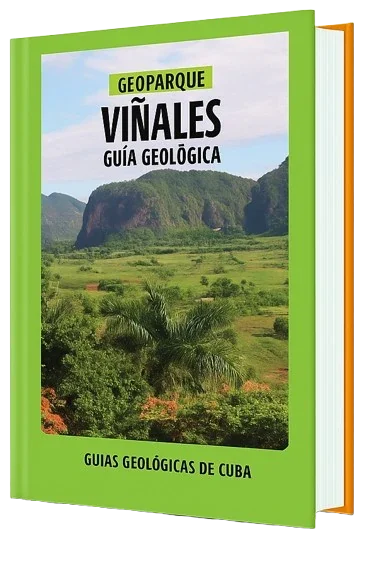
Discover it in our geological guide to Viñales Geopark!
These are just some of the fundamental concepts that will help you appreciate the geology around you. If your curiosity is piqued and you wish to delve deeper into Viñales’ geological secrets, we invite you to acquire our complete guide.
GEOHERITAGE
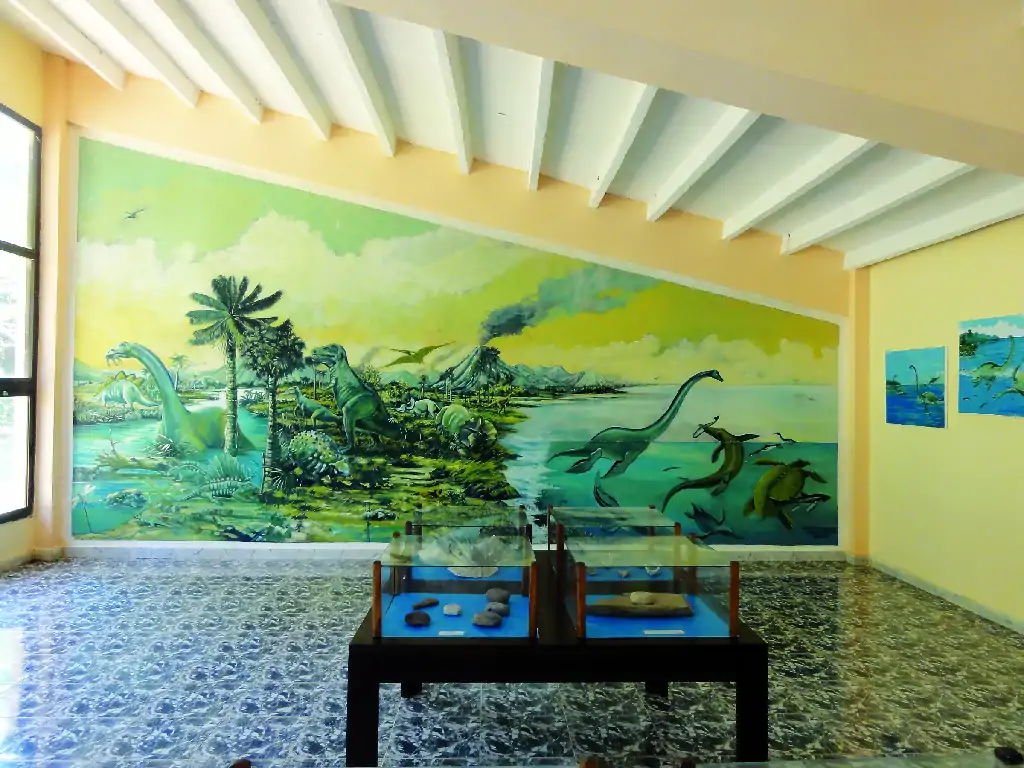
The geoheritage of Viñales Geopark comprises an exceptional set of geological resources of high scientific and educational value. Its imposing mogotes and karst valleys, formed on Jurassic-Cretaceous limestones, reveal the marine origin of the territory. The area preserves important fossil records, including ammonites, corals, and petrified palms, documenting the evolution of life and past climates. Active karst processes, such as cave and sinkhole formation, offer a natural laboratory for studying geological dynamics. This geological heritage, integrated with the cultural tobacco-growing landscape, constitutes a unique archive for understanding the geological history of the Caribbean and its relationship with current ecosystems.
GEOCONSERVATION
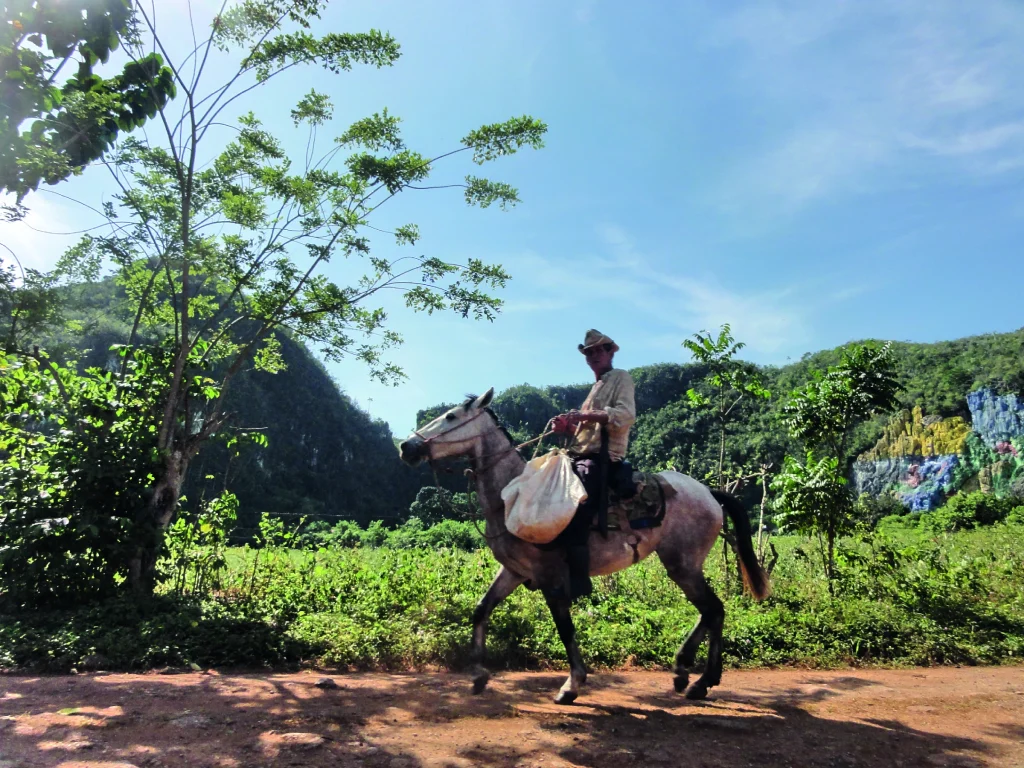
Geoparks must contribute to ensuring the conservation of heritage elements over time, as well as the ecosystems that compose these territories, especially considering the current environmental crisis. Valuing Earth's heritage and recognizing it is a commitment to protection and conservation. It supports sustainable tourism in Viñales Geopark.
GEOEDUCATION
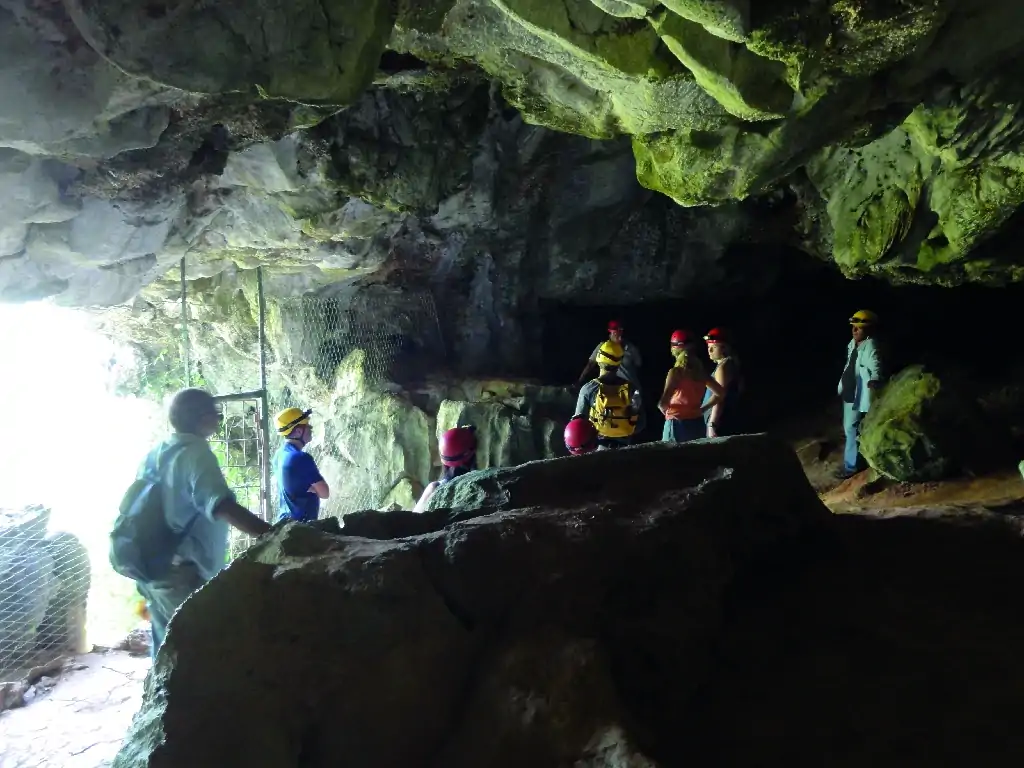
Viñales Geopark's fundamental objective is to actively participate in education by supporting the work of formal educational institutions within the Geopark's territory. Through geoeducation in Viñales, the encounter of knowledge is promoted in a living territory that transforms into an open classroom for students and visitors. Outdoor educational experiences are generated on global and local issues, such as conservation, climate change, and natural disaster risk prevention, learning from geological records and their links with the natural and cultural (tangible and intangible) heritage of our Geopark.
GEOTOURISM
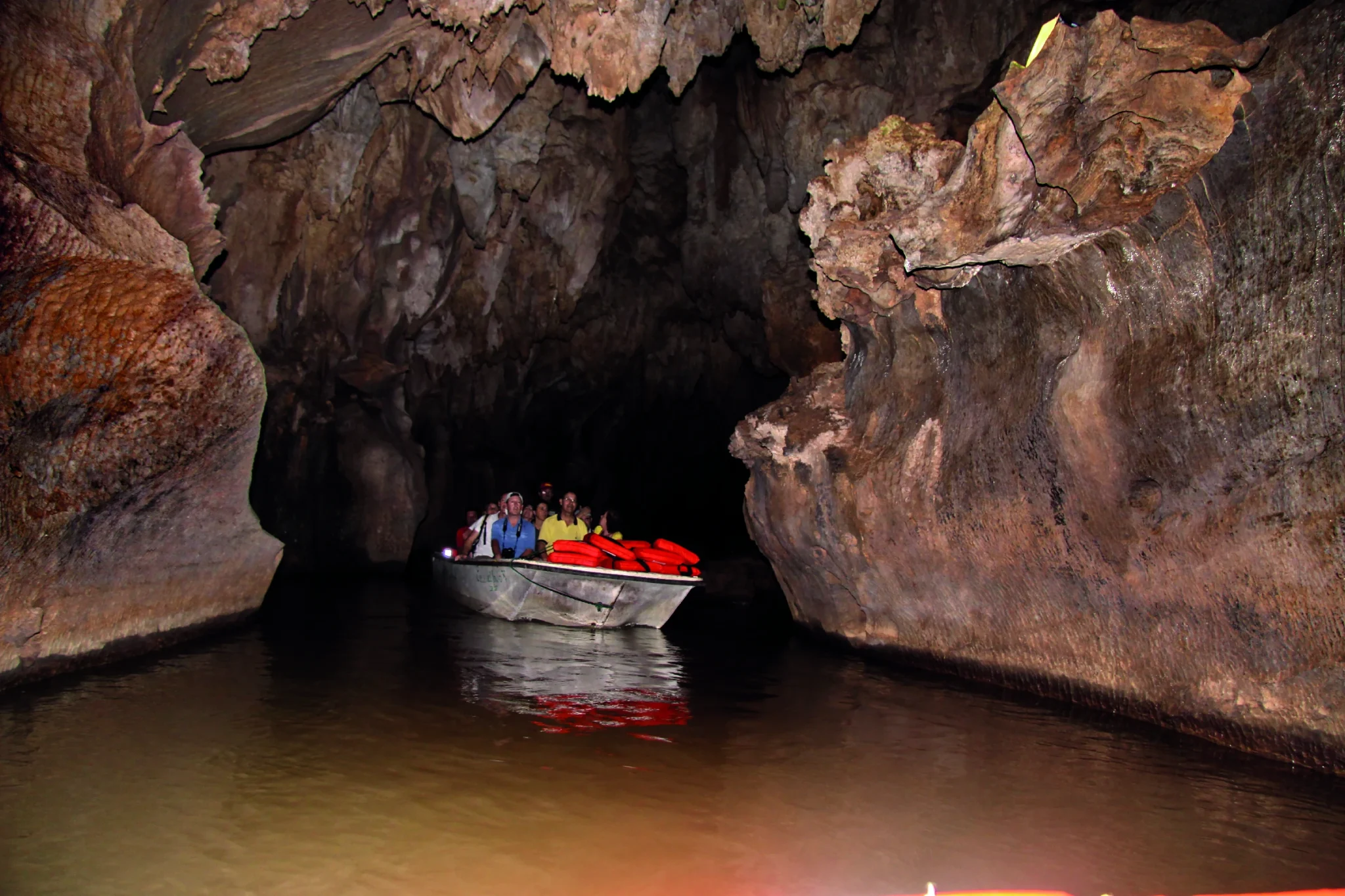
One of the Geopark's pillars is geotourism, defined as "tourism that sustains and enhances the identity of a territory, considering its geology, environment, culture, aesthetics, heritage, and the well-being of its residents." It is also a sustainable development strategy for local communities. In Viñales Geopark, you can experience geotourism that connects you to Earth's memory.
GEOPRODUCTIONS
Geoparks aim to improve the quality of life of their communities through the sustainable use of their geological heritage. Geoproduction involves creating goods and services that value this natural legacy, integrating traditional knowledge and endogenous resources. Viñales Geopark fosters local initiatives that highlight its geodiversity, from ancestral agricultural productions to cultural expressions. Crafts, art, gastronomy, and designs inspired by geology can become authentic geoproducts. These not only make geological history and landscape evolution visible but also dignify territorial identity. The link between geodiversity and local creativity generates sustainable economic opportunities. Thus, rock, relief, and fossils become engines of community development. The key lies in balancing conservation, innovation, and tradition. Each geoproduct tells a millennia-old story and strengthens pride in the territory. This approach turns geological heritage into a living resource for collective well-being.
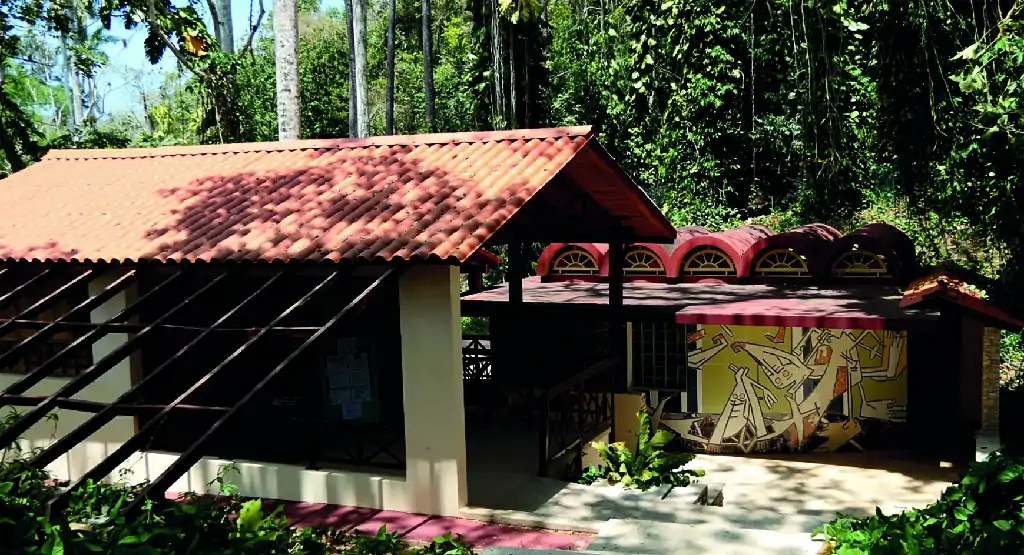
HISTORIC SITES
Among mogotes and valleys, the Geopark hides colonial legacies, aboriginal caves, and scenes of independence struggles. Over 80 documented sites speak of resistance, traditions, and culture.
Monument Complex Los Malagones.
A tribute to the 12 brave men who in 1959 formed Cuba’s first peasant militia to combat banditry in Pinar del Río. Recognized with the XX Anniversary Medal of the FAR for their heroism.
- First Peasant Militia of the Revolution